
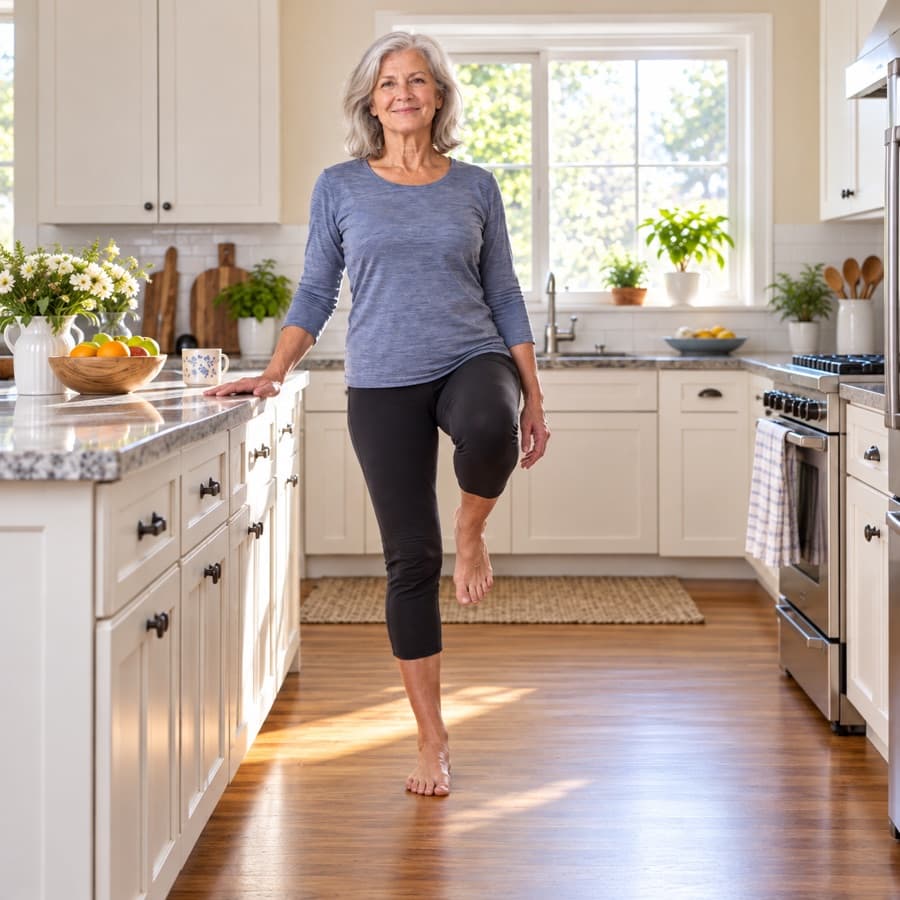
Why guidelines include it
U.S. and WHO guidelines for older adults include balance training alongside aerobic and strength activity. WHO describes the aim as supporting everyday function and lowering the risk of falls.
That is a statement about what is advised for older adults in general. It is not a promise about any one person.
Before you start
- If you have fallen, feel unsteady, get dizzy, or have numbness in your feet, talk with a clinician or physical therapist first.
- Practice only where you can grab something sturdy with either hand: a kitchen counter is ideal.
- Clear the floor, wear stable shoes or go barefoot on a non-slip surface, and have someone nearby if you can.
A first practice
The step below is the same one Fit after 50 members can be given. It takes about five minutes and always keeps support within reach.
Practice five minutes of supported balance
About 5 minutes · Easy. Keep a hand on the counter the whole time.
Stand beside a stable counter or chair and practice comfortable weight shifts with support within reach.
- You will need
- A stable kitchen counter or sturdy chair to hold, and a clear floor.
- How hard
- Easy. Keep a hand on the counter the whole time.
- Done when
- You practiced shifting your weight for a few minutes, with support in reach.
- Stand beside the counter with one hand resting on it.
- Slowly shift your weight onto one foot, then back to the middle.
- Slowly shift your weight onto the other foot.
- Keep going at a calm pace for about five minutes, resting whenever you like.
Safety: Keep stable support within reach. Do not attempt this if standing balance is unsafe for you.
Evidence strength: strong. General information, not medical advice.
Learn more: Fitness after 50
Progressing without taking risks
- Change only one thing at a time: a narrower stance, or lighter hand support.
- Move from feet apart, to feet together, to one foot slightly in front of the other, while still holding the counter.
- Reduce hand support to a fingertip only when the position feels steady.
- Stop and rest whenever you like. Practice is not a test.
Fit it into your day
Many people practice while the kettle heats or the coffee brews, standing by the counter. Short, frequent practice is easier to keep than a long session.
What this does not tell you
It cannot tell you your risk of falling, and it is not a balance test. If you are worried about your balance, a clinician can assess it properly.
Where to go next
- Strength training after 50 Leg strength and balance work well together.
- Weekly Activity Check
- How much exercise do adults over 50 need?
About the evidence on this page
- Review status
- Claims source-checked
- Last updated
- Claims source-checked
- Clinician review
- None recorded. No physician or other licensed clinician has reviewed this page.
Each claim listed below was compared with the named sources. The checks were prepared with AI assistance and the ratings are proposed, pending confirmation by a person. Everything else on this page is general guidance, not a separately reviewed claim.
Claims we checked
- Strong evidenceOlder-adult guidelines support multicomponent activity that includes balance training.Consistent support from authoritative guidelines for the narrow claim made here.Limits: Practice only with stable support within reach. Not appropriate if standing balance is unsafe for you.
- Strong evidenceFor adults 65 and over, WHO advises varied multicomponent physical activity that emphasizes functional balance and strength training at moderate or greater intensity on 3 or more days a week.Consistent support from authoritative guidelines for the narrow claim made here.This rating is proposed, pending confirmation by a person.Limits: This applies to adults 65 and over. Adults 50 to 64 follow the general adult guidance. Not appropriate to attempt if standing balance is unsafe for you; ask a clinician or physical therapist first.
- Strong evidenceAdults who cannot meet the recommended amounts because of chronic conditions are advised to be as physically active as their abilities and conditions allow.Consistent support from authoritative guidelines for the narrow claim made here.This rating is proposed, pending confirmation by a person.Limits: This is why Fit after 50 tells anyone with a condition or symptoms to ask a clinician what is right for them.
Sources
- Physical Activity Guidelines for Americans, 2nd edition, U.S. Department of Health and Human Services (2018)
- WHO guidelines on physical activity and sedentary behaviour, World Health Organization (2020)
Limitations
- This is general education, not individualized medical advice.
- Guidelines describe what is advised for adults in general. They are not a prescription for one person.
- Talk with a clinician if you have a health condition, symptoms, or restrictions.
Update history
- : First version published.