
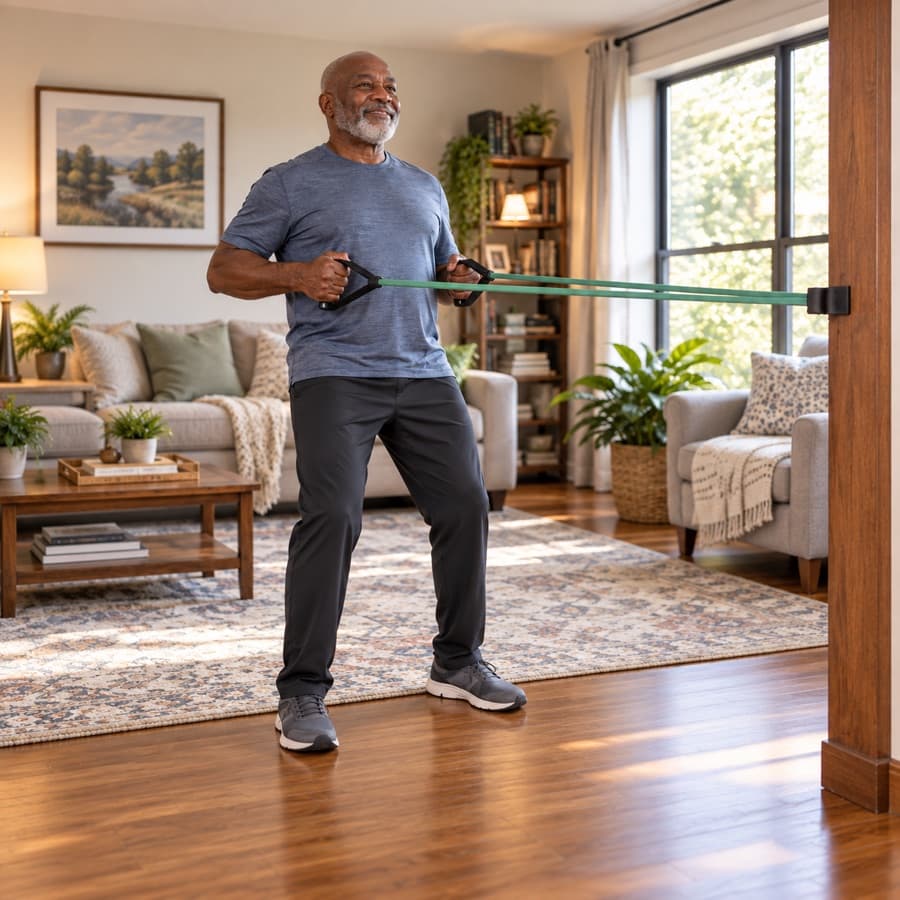
What counts as strength training
Muscle-strengthening means making your muscles work against resistance. That can be your own body weight, resistance bands, weights, or heavy gardening such as digging.
Guidelines say to work all the major muscle groups: legs, hips, back, abdomen, chest, shoulders, and arms. You do not need a gym to do this.
How often
Guidelines advise it on 2 or more days a week, at a moderate or greater effort. Moderate means it feels like real work but stays controlled. It should never feel painful or unsteady.
A comfortable place to begin
The step below is the same one Fit after 50 members can be given. It uses a sturdy chair and takes about five minutes. Start with it on two days this week.
Do one comfortable chair-strength set
About 5 minutes · Easy to moderate. It should never feel painful or unsteady.
From a stable chair, try up to five comfortable sit-to-stands, using the chair arms if helpful.
- You will need
- A sturdy chair that will not slide, placed against a wall.
- How hard
- Easy to moderate. It should never feel painful or unsteady.
- Done when
- You did up to five comfortable stands, or as many as felt fine.
- Sit toward the front of the chair, feet flat.
- Lean slightly forward and stand up, using the arms of the chair if helpful.
- Sit back down slowly.
- Repeat up to five times, resting whenever you like.
Safety: Use a chair that will not slide and keep support nearby. Stop for pain or loss of balance.
Evidence strength: strong. General information, not medical advice.
Learn more: Beginner's guide to getting fit after 50
Making it a little harder, safely
- Change one thing at a time: a few more repetitions, a slower lowering, or less help from the chair arms.
- Add another movement only when the first feels easy and steady.
- Many people find a day between sessions comfortable. Listen to your body.
- Breathe steadily. Do not hold your breath.
When to stop or ask first
Muscle effort is normal. Sharp pain, joint pain, dizziness, or loss of balance is a reason to stop.
If you have a health condition, a recent surgery or injury, or restrictions from a clinician, ask what is right for you before you begin. A physical therapist can help you tailor strength work to your situation.
What this does not tell you
It does not say how much muscle you will build or how fast. Results vary, and this is general education, not individual advice.
Where to go next
About the evidence on this page
- Review status
- Claims source-checked
- Last updated
- Claims source-checked
- Clinician review
- None recorded. No physician or other licensed clinician has reviewed this page.
Each claim listed below was compared with the named sources. The checks were prepared with AI assistance and the ratings are proposed, pending confirmation by a person. Everything else on this page is general guidance, not a separately reviewed claim.
Claims we checked
- Strong evidenceGuidelines advise muscle-strengthening activity of moderate or greater intensity that works all the major muscle groups on 2 or more days a week.Consistent support from authoritative guidelines for the narrow claim made here.This rating is proposed, pending confirmation by a person.Limits: Population-level guidance, not an individual prescription. Start at a level that is comfortable and build gradually.
- Strong evidenceGuidelines support muscle-strengthening activity for adults, including older adults.Consistent support from authoritative guidelines for the narrow claim made here.Limits: A chair-based set is a low-volume option, not a universal prescription. Stop for pain or loss of balance.
- Strong evidenceGuidelines state that some physical activity is better than none, and that any amount of moderate-to-vigorous activity counts toward the weekly total.Consistent support from authoritative guidelines for the narrow claim made here.This rating is proposed, pending confirmation by a person.Limits: This says a small amount counts. It does not say a small amount is enough for every goal.
- Strong evidenceAdults who cannot meet the recommended amounts because of chronic conditions are advised to be as physically active as their abilities and conditions allow.Consistent support from authoritative guidelines for the narrow claim made here.This rating is proposed, pending confirmation by a person.Limits: This is why Fit after 50 tells anyone with a condition or symptoms to ask a clinician what is right for them.
Sources
- Physical Activity Guidelines for Americans, 2nd edition, U.S. Department of Health and Human Services (2018)
- WHO guidelines on physical activity and sedentary behaviour, World Health Organization (2020)
Limitations
- This is general education, not individualized medical advice.
- Guidelines describe what is advised for adults in general. They are not a prescription for one person.
- Talk with a clinician if you have a health condition, symptoms, or restrictions.
Update history
- : First version published.