
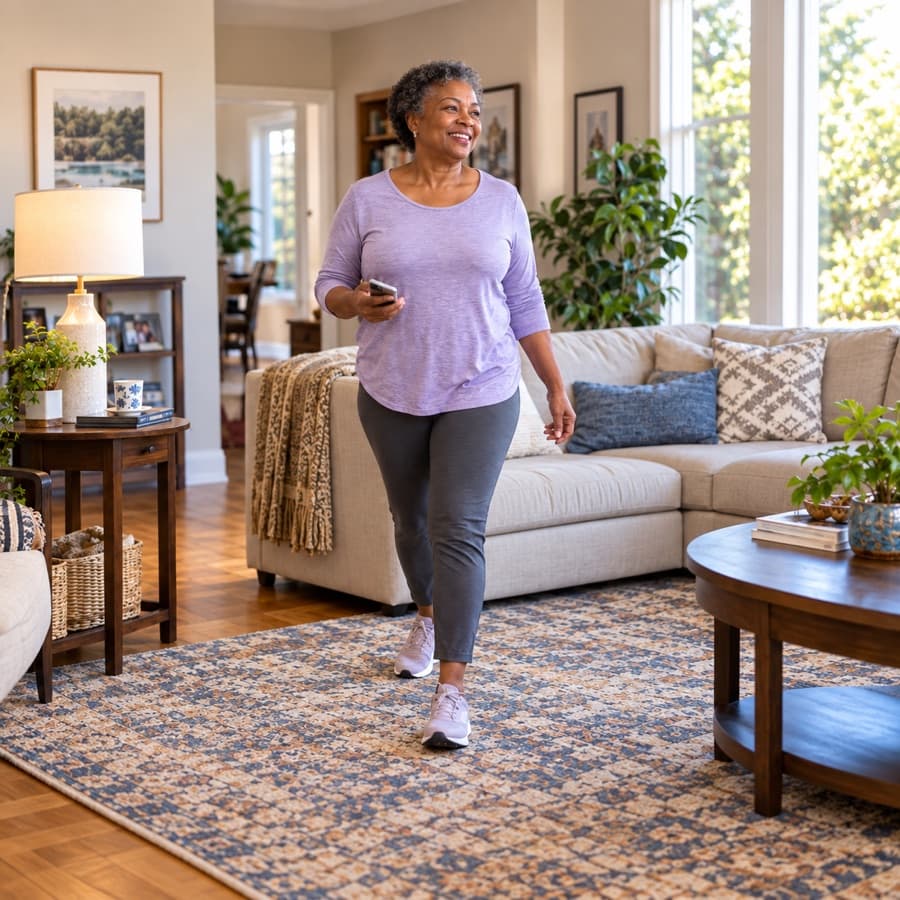
What everyday capability means
It is doing what you want to do without a struggle: standing up from a chair, climbing stairs, stepping onto a curb, carrying groceries, getting in and out of the bathtub. It is built from leg strength, balance, and a home that helps rather than trips you.
Four things CDC says you can do
- Speak up. Talk openly with your healthcare provider about fall risks and prevention, and ask your doctor or pharmacist to review your medicines.
- Keep moving. Begin an exercise program to improve your leg strength and balance.
- Get an annual eye exam, and replace eyeglasses as needed.
- Make your home safer. Remove clutter and tripping hazards.
Check where you are
CDC publishes tools that clinicians use. Fit after 50 offers self-guided versions with extra safety steps. Each is a screening result, not a diagnosis, and each says where it stops.
- Fall-Risk Checklist: CDC's 12 statements. A score of 4 or more may mean a risk for falling, and CDC says to discuss it with your doctor. Nothing is stored.
- 30-Second Chair Stand: a leg-strength check with CDC's reference numbers for ages 60 and over.
- 4-Stage Balance Check: needs a helper and a sturdy counter. Not for anyone who has fallen in the past year or feels unsteady.
Make your home safer
The first step below is the same one Fit after 50 members can be given, and the two after it build leg strength and balance. CDC's Check for Safety checklist lists common hazards on stairs, floors, in the kitchen, bedrooms, and bathrooms, with a fix for each. Fixing one is a real start, and it is fine to ask someone to help.
Find and fix one home hazard
About 10 minutes · Easy. Ask for help with anything heavy or high.
Walk through one room with the CDC home checklist in mind, pick one hazard, and fix it or ask someone to help you fix it.
- How to start
- Pick one room. Look at the floor and the lighting first: clear a cord, remove a loose rug, or put a light where you need one.
- You will need
- A room you can walk through, and the free Home Safety Checklist.
- How hard
- Easy. Ask for help with anything heavy or high.
- Done when
- You fixed one hazard, or you asked someone to help you fix it.
Safety: Do not climb, reach, or lift anything that feels unsafe. Ask someone to help with stairs, ladders, or electrical work.
Evidence strength: moderate. General information, not medical advice.
Learn more: Home Safety Checklist
Do one comfortable chair-strength set
About 5 minutes · Easy to moderate. It should never feel painful or unsteady.
From a stable chair, try up to five comfortable sit-to-stands, using the chair arms if helpful.
- You will need
- A sturdy chair that will not slide, placed against a wall.
- How hard
- Easy to moderate. It should never feel painful or unsteady.
- Done when
- You did up to five comfortable stands, or as many as felt fine.
- Sit toward the front of the chair, feet flat.
- Lean slightly forward and stand up, using the arms of the chair if helpful.
- Sit back down slowly.
- Repeat up to five times, resting whenever you like.
Safety: Use a chair that will not slide and keep support nearby. Stop for pain or loss of balance.
Evidence strength: strong. General information, not medical advice.
Learn more: Beginner's guide to getting fit after 50
Practice five minutes of supported balance
About 5 minutes · Easy. Keep a hand on the counter the whole time.
Stand beside a stable counter or chair and practice comfortable weight shifts with support within reach.
- You will need
- A stable kitchen counter or sturdy chair to hold, and a clear floor.
- How hard
- Easy. Keep a hand on the counter the whole time.
- Done when
- You practiced shifting your weight for a few minutes, with support in reach.
- Stand beside the counter with one hand resting on it.
- Slowly shift your weight onto one foot, then back to the middle.
- Slowly shift your weight onto the other foot.
- Keep going at a calm pace for about five minutes, resting whenever you like.
Safety: Keep stable support within reach. Do not attempt this if standing balance is unsafe for you.
Evidence strength: strong. General information, not medical advice.
Learn more: Fitness after 50
Build leg strength and balance
Leg strength and balance work well together. Two guides show comfortable ways to start at home: strength with a sturdy chair, and supported balance beside a counter.
When to talk with a clinician or physical therapist
A physical therapist can assess your balance and build a safe program for you.
- You have fallen, or you feel unsteady or dizzy.
- You need to push with your hands to stand up from a chair.
- Your checklist score is 4 or more, or your tandem stand is under 10 seconds.
- You have lost some feeling in your feet, or your medicines make you light-headed.
What this does not tell you
It cannot tell you whether you will fall, and none of the checks is a diagnosis. We checked what CDC's documents say. We did not review the studies behind their reference numbers, and no clinician has reviewed this page.
Where to go next
About the evidence on this page
- Review status
- Claims source-checked
- Last updated
- Claims source-checked
- Clinician review
- None recorded. No physician or other licensed clinician has reviewed this page.
Each claim listed below was compared with the named sources. The checks were prepared with AI assistance and the ratings are proposed, pending confirmation by a person. Everything else on this page is general guidance, not a separately reviewed claim.
Claims we checked
- Moderate evidenceCDC's Check for Safety checklist lists common home hazards on stairs, floors, in the kitchen, bedrooms, and bathrooms, with a recommended fix for each.Supportive guidance exists, with more limits or less consistency than a strong rating.This rating is proposed, pending confirmation by a person.Limits: We checked what CDC's document lists. We did not review studies on how much each fix helps. It is a checklist of common hazards, not a full home assessment.
- Moderate evidenceCDC's STEADI 30-Second Chair Stand lists below-average scores by age and sex for adults 60 to 94, and says a below-average score indicates a risk for falls.Supportive guidance exists, with more limits or less consistency than a strong rating.This rating is proposed, pending confirmation by a person.Limits: We checked what CDC's document says. We did not review the studies behind the reference numbers. CDC designed the test for clinicians to use with patients. Fit after 50 offers a self-guided version with extra safety steps. It does not diagnose anything, and the reference numbers start at age 60.
- Moderate evidenceCDC's STEADI 4-Stage Balance Test says an older adult who cannot hold the tandem stand for at least 10 seconds is at increased risk of falling.Supportive guidance exists, with more limits or less consistency than a strong rating.This rating is proposed, pending confirmation by a person.Limits: We checked what CDC's document says. We did not review the studies behind it. CDC's protocol has a clinician standing next to the person. Fit after 50 requires a helper and a sturdy counter, and stops if either is missing. It does not diagnose anything.
- Moderate evidenceCDC's Stay Independent checklist adds points for 12 statements and says a total of 4 or more may mean a risk for falling and to discuss it with your doctor. CDC calls it a validated self-assessment tool.Supportive guidance exists, with more limits or less consistency than a strong rating.This rating is proposed, pending confirmation by a person.Limits: We checked what CDC's document says. We did not review the validation study. It is a screening checklist, not a diagnosis. Answers are not stored by Fit after 50.
- Strong evidenceFor adults 65 and over, WHO advises varied multicomponent physical activity that emphasizes functional balance and strength training at moderate or greater intensity on 3 or more days a week.Consistent support from authoritative guidelines for the narrow claim made here.This rating is proposed, pending confirmation by a person.Limits: This applies to adults 65 and over. Adults 50 to 64 follow the general adult guidance. Not appropriate to attempt if standing balance is unsafe for you; ask a clinician or physical therapist first.
- Strong evidenceGuidelines support muscle-strengthening activity for adults, including older adults.Consistent support from authoritative guidelines for the narrow claim made here.Limits: A chair-based set is a low-volume option, not a universal prescription. Stop for pain or loss of balance.
Sources
- Check for Safety: A Home Fall Prevention Checklist for Older Adults, CDC, National Center for Injury Prevention and Control (2017)
- STEADI Assessment: 30-Second Chair Stand, CDC, National Center for Injury Prevention and Control (2017)
- STEADI Assessment: The 4-Stage Balance Test, CDC, National Center for Injury Prevention and Control (2017)
- Stay Independent: Learn more about fall prevention, CDC, National Center for Injury Prevention and Control (2023)
- WHO guidelines on physical activity and sedentary behaviour, World Health Organization (2020)
- Physical Activity Guidelines for Americans, 2nd edition, U.S. Department of Health and Human Services (2018)
Limitations
- This is general education, not individualized medical advice.
- Guidelines describe what is advised for adults in general. They are not a prescription for one person.
- Talk with a clinician if you have a health condition, symptoms, or restrictions.
Update history
- : First version published.