
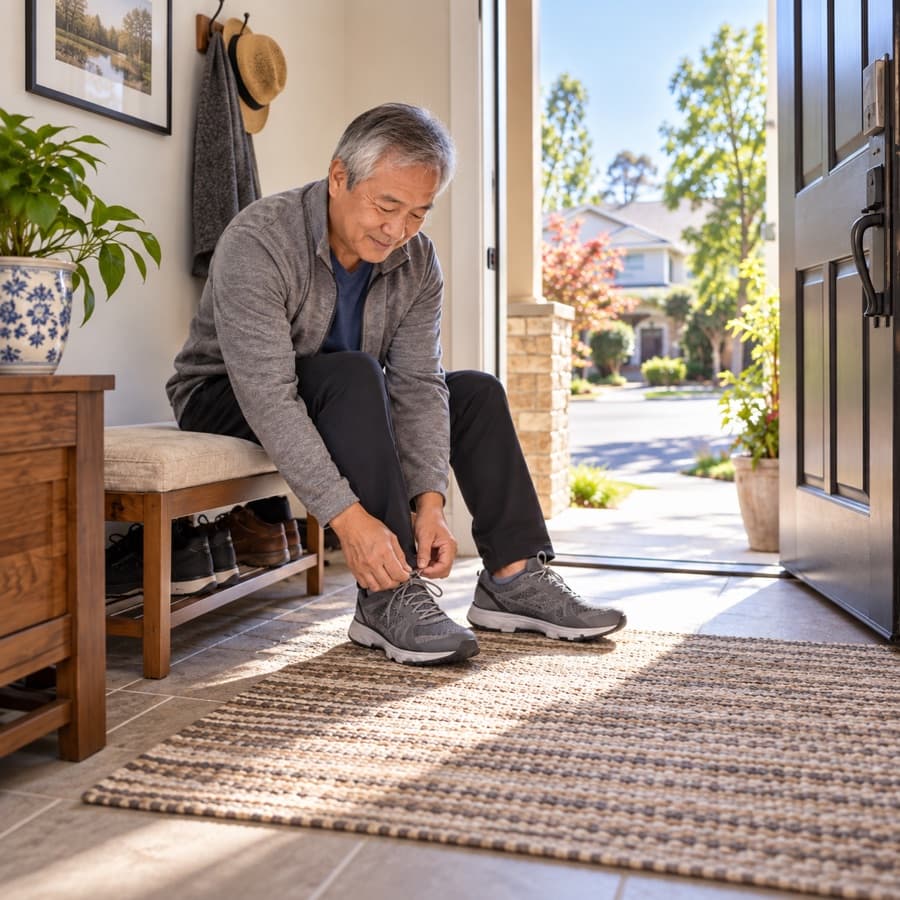
Why walking is a good place to start
A short walk adds to your total weekly activity, and guidelines state that some activity is better than none. Walking needs no equipment, no membership, and no special skill.
Guidelines also advise sitting less. A walk is one of the easiest ways to break up long stretches of sitting.
Your first walk
Ten comfortable minutes is a real start. The step below is the same one Fit after 50 members can be given.
Take a comfortable 10-minute walk
About 10 minutes · Easy
Choose a familiar, safe route and walk at a pace that feels comfortable today.
- How to start
- Step outside, pick a familiar route, and set a 10-minute timer. Turn around at the halfway point.
- You will need
- Comfortable shoes and a route you already know.
- How hard
- Easy: a pace where you can still talk comfortably.
- Done when
- You walked for about ten minutes, or as long as felt comfortable.
Involves: being outdoors.
Safety: Use a route and pace that are appropriate for you. Stop for a new concerning symptom.
Evidence strength: strong. General information, not medical advice.
Learn more: Fitness after 50
Take a comfortable 10-minute walk indoors
About 10 minutes · Easy
Walk at a comfortable pace around your home, a hallway, or a shopping center, and stop when the time is up.
- How to start
- Choose a loop indoors that is clear and well lit, and set a 10-minute timer.
- You will need
- Comfortable shoes and a clear path indoors.
- How hard
- Easy: a pace where you can still talk comfortably.
- Done when
- You walked for about ten minutes, or as long as felt comfortable.
Safety: Use a route and pace that are appropriate for you. Stop for a new concerning symptom.
Evidence strength: strong. General information, not medical advice.
Learn more: Fitness after 50
How hard should it feel
For your first walks, easy is fine. A common rule of thumb for moderate effort is that you can talk but not sing. Use your own comfort as the guide. If you cannot talk at all, slow down.
Building up
- When ten minutes feels easy, add a few minutes at a time.
- Spread walks across the week, since any amount counts toward your total.
- A slightly brisker pace is a good next step once the time feels comfortable.
- Vary the route so it stays interesting.
Make it easier to start
- Put your walking shoes by the door.
- Walk at the same time as something you already do, such as after a meal.
- Ask a friend to walk with you. It counts as connection too.
- On days you would rather stay in, walk indoors: a hallway, a lap of the house, or a shopping center.
Safety
Choose a familiar, well-lit route with a surface you trust, and wear supportive shoes. In heat, cold, or poor air quality, choose an indoor walk instead.
Stop and get medical advice for chest pain, unusual shortness of breath, dizziness, or any new concerning symptom.
What this does not tell you
It does not promise a specific result from ten minutes. It says a short walk counts toward your week, which is a good reason to begin.
Where to go next
About the evidence on this page
- Review status
- Claims source-checked
- Last updated
- Claims source-checked
- Clinician review
- None recorded. No physician or other licensed clinician has reviewed this page.
Each claim listed below was compared with the named sources. The checks were prepared with AI assistance and the ratings are proposed, pending confirmation by a person. Everything else on this page is general guidance, not a separately reviewed claim.
Claims we checked
- Strong evidenceA short walk contributes to a person's total weekly physical activity.Consistent support from authoritative guidelines for the narrow claim made here.Limits: We do not claim that ten minutes alone produces a clinical outcome. Pace and route need to match the person's ability.
- Strong evidenceFor substantial health benefits, guidelines advise adults to do at least 150 to 300 minutes of moderate-intensity aerobic activity a week, or 75 to 150 minutes of vigorous activity, or an equivalent combination.Consistent support from authoritative guidelines for the narrow claim made here.This rating is proposed, pending confirmation by a person.Limits: These are population-level guidelines, not an individual prescription. People who cannot reach these amounts because of a chronic condition are advised to be as active as their abilities and conditions allow.
- Strong evidenceGuidelines state that some physical activity is better than none, and that any amount of moderate-to-vigorous activity counts toward the weekly total.Consistent support from authoritative guidelines for the narrow claim made here.This rating is proposed, pending confirmation by a person.Limits: This says a small amount counts. It does not say a small amount is enough for every goal.
- Strong evidenceGuidelines advise adults to limit the time they spend sitting and to replace it with physical activity of any intensity.Consistent support from authoritative guidelines for the narrow claim made here.This rating is proposed, pending confirmation by a person.Limits: Population-level advice. It does not set one exact number of sitting minutes for an individual.
- Strong evidenceAdults who cannot meet the recommended amounts because of chronic conditions are advised to be as physically active as their abilities and conditions allow.Consistent support from authoritative guidelines for the narrow claim made here.This rating is proposed, pending confirmation by a person.Limits: This is why Fit after 50 tells anyone with a condition or symptoms to ask a clinician what is right for them.
Sources
- Physical Activity Guidelines for Americans, 2nd edition, U.S. Department of Health and Human Services (2018)
- WHO guidelines on physical activity and sedentary behaviour, World Health Organization (2020)
Limitations
- This is general education, not individualized medical advice.
- Guidelines describe what is advised for adults in general. They are not a prescription for one person.
- Talk with a clinician if you have a health condition, symptoms, or restrictions.
Update history
- : First version published.